Stories
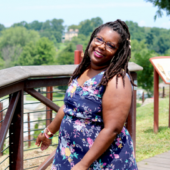
Candace's Story
When people consider domestic violence (DV), they often think of the adult victim/survivor. But what about the children who have seen or experienced the abuse; the boys, girls and young adults who have been afraid in their own home? Candace, who worked as a therapist at Women Against Abuse, witnessed her mother being abused for many years, is choosing to share her story to shine a light on this little told aspect of DV. These are her words.
I journal a lot. One of the questions I have been meditating on is ‘who would you be if you didn’t believe something was wrong with you?’ I have been trying to figure that out. The job title, the mom title, the degree, all of this success, it looks great. Someone looking in thinks you’ve got it all together. You meditate every day, you’re a therapist, you and your kids have a great relationship. But it’s the silent, internal battles that no one sees. When the kids are asleep and the lights are off, those constant little reminders of being a child survivor of DV that no one talks about.
I am the oldest of four and my family is from a Caribbean background, where the oldest is very close to their mom and the next in line. So I saw it all. I was my mom’s firstborn and we were very enmeshed; I was very parentified, so she told me everything. Instead of being a child, I emotionally took care of my mom, which put a lot on me.
And then [my dad] tried to take the frustration and anger out on us, and when you’re young, you don’t know what to do. You’re harmless. You don’t know how to defend yourself or what to say. And I think for a long time I made this excuse up: he was in prison for nine years and saw a lot. He had a rough childhood, but those excuses are just excuses. No matter what you’ve been through, I don’t think if you love someone, you should do that.
Back then, it was like three strikes and you’re out, and my dad already had two strikes on him, so if we called the cops, he’d go away for life and we’d never see him again. So, it was like you literally learn to survive.
People knew about it, but I think after a while people gave up because they were just like ‘what can you really do?’ I remember growing up, my aunt said, ‘Once you’re old enough, go to college and get away.’
But I had my first son at age 18, literally right after high school, so I wasn’t able to go away. I remoted in [from Community College of Philadelphia]; but my sister did go away to college, and I worked two jobs to make sure that she stayed in college and helped her – paid her cell phone bill and made sure she ate.
After about 30 years of my dad just being him, he left my mom for another woman and got remarried and lives in Atlanta. We don’t talk, but my mom lives like 10 minutes away from me, and we’re close. Not as close as we used to be, but close enough in a healthy way now.
A lot of people ask if I purposefully chose to be a therapist at Women Against Abuse because of my past, but I didn’t. I wanted to break into business, but it was something about sociology and trauma when it comes to the brain and behavior, and I just fell in love with it.
There are some days hearing these stories, I come home and am just like, ‘I gotta sleep.’ It’s very draining. Every time I feel like I’m halfway making it in therapy, there’s something else that comes up I didn’t even know was there.
When a child is exposed to so much at a young age – my first exposure was at the age of five but it became big for me at the age of seven – even though, biologically, you grow up, there is a part of you still at that age that you started with that trauma. I notice sometimes with my clients if they start yelling because they’re upset, I automatically become that seven-year-old. And I have to snap myself out of it and remind myself, ‘Ok, Candace, you’re ok, you’re safe.’
I can relate more to my clients now than I ever did before because of talking about the trauma and sticking with therapy for five, six years. I still don’t feel free. One of my Buddhist meditation practices is to let go of your fears. I went to my therapist and said, ‘There are so many fears – not having enough money, fear that my kids – who are Black kids – won’t have the opportunity to reach adulthood, but my biggest fear is that I will always be seven years old and trapped internally.’
But it was the helpers and the programs at school that helped me, mentors who showed me I can do something else. That's why I’m sharing my story. So people can see beyond just the scope of my degree or my kindness. There are internal things happening behind the scenes that people don’t see. It was the social workers, the teachers, the school district’s ELECT program and Turning Points for Children who literally guided me into who I wanted to be. If it wasn’t for them, I wholeheartedly think I would have gone a totally different way.
There’s good days now – when I talk with clients and I do see the difference. When I get certain messages or phone calls from clients who say, ‘You’ve helped me out so much.’ There are times when I can grasp that and understand it...but then there are days, when something small like a breakup feels huge and I’m literally trying to rewire my brain all over again.
[Healing from trauma] looks different for everyone, but just being able to have genuine tools and compassion to say, ‘Hey, I see you, I hear you, and I'm not trying to fix you. I literally just want to be here for you’ is the biggest thing ever. And that’s what I bring to my clients. I'm here to listen and guide you in whatever direction you want to lead.
If you or someone you know needs help, call our toll-free 24-hour Hotline: